

Abdul Momen Khan
In Memory of Abdul Momen Khan
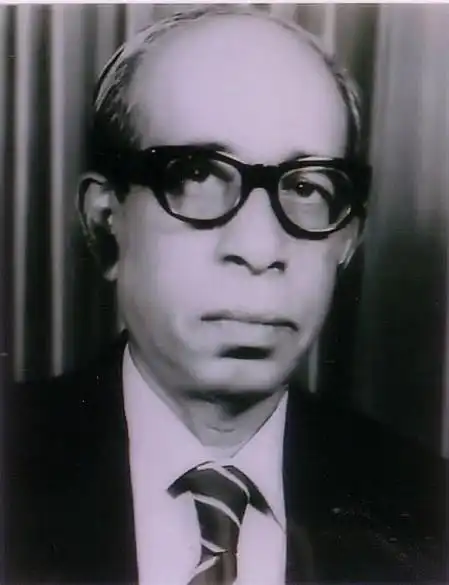
Abdul Momen Khan was a distinguished Bangladeshi statesman and public servant who served as Cabinet Secretary from 1976 to 1977 and Minister of Food from 1977 to 1982, before being elected to Parliament from Narsingdi-1 in 1979. Over a career spanning the civil service, national government, and elected office, he was known for his intellect, integrity, and deep commitment to public service. Remembered particularly for his contribution to the development of Narsingdi and his dedication to the welfare of its people, his legacy of service continues through the work carried forward in his name. Born in 1919 in Charnagardi village, in what is now Palash Upazila of Narsingdi District, Abdul Momen Khan grew up in a family in which education, principle, and public responsibility were deeply valued. His father, Abdul Bari Khan, was a teacher and a follower of Mahatma Gandhi who was imprisoned for his involvement in the movement against British rule. From an early age, Abdul Momen Khan distinguished himself academically. After completing his schooling at Kaliganj Raja Kali Narayan High School, he went on to place fifth in undivided Bengal—and first among Muslim students—in the Intermediate Examination under the University of Calcutta. He subsequently earned both his bachelor’s and master’s degrees in Economics from the University of Dhaka before successfully completing the Public Service Commission examination and joining the Bengal Civil Service.
A Distinguished Life in Public Service
Abdul Momen Khan went on to build an exceptional career in public administration.
Over the course of his service, he held a succession of senior positions, including
Chairman of the Khulna Development Authority, Divisional Commissioner of Khulna,
Secretary in key government departments, Secretary of the Bangladesh National
Parliament, and ultimately Cabinet Secretary—the highest-ranking position in the
country’s civil service.
His reputation was built not only on the offices he held, but on the seriousness with
which he approached them. His academic ability, administrative discipline, and
commitment to public duty were evident throughout his career. During senior civil
service training in Lahore, he graduated first in his course and received valedictorian
honours.
In 1977, Abdul Momen Khan entered national political leadership when he was invited
to serve on President Ziaur Rahman’s Advisory Council and was appointed Minister of
Food. Two years later, he was elected to Parliament from Narsingdi-1. In the 1979
parliamentary election, he received the highest number of votes cast for any candidate
across Bangladesh’s 300 constituencies, a striking reflection of the public confidence he
commanded.
He served as Minister of Food until 1982, during a period when food security was
among the country’s most consequential national challenges. In that capacity, he also
represented Bangladesh internationally, leading national delegations to conferences of
the United Nations World Food Programme and the Food and Agriculture Organization.
A Lasting Connection to Narsingdi
For the people of Narsingdi, Abdul Momen Khan’s legacy was also intensely local.
Throughout his public life, he remained closely connected to the community from which
he came. He played an important role in the administrative development of the region,
including the establishment of Narsingdi as a subdivision and the development of
Palash as a thana. His contribution to the area’s progress earned him enduring respect
among local communities and recognition as an important figure in the emergence of
modern Narsingdi.
Yet public service, for Abdul Momen Khan, extended beyond government. He was
deeply engaged in social welfare and believed that public responsibility ultimately meant
improving the lives and opportunities of ordinary people. It is this spirit of service, rooted
in community, education, dignity, and opportunity, that forms the most enduring part of
his legacy.
A Legacy Carried Forward
Abdul Momen Khan passed away on 12 December 1984 and was laid to rest in his
home village of Charnagardi, among the community to which he remained connected
throughout his life.
His legacy, however, did not end with his lifetime.
The Abdul Momen Khan Memorial Foundation was established in his memory to
carry forward the values that defined his life: a belief in education, service to others, and
the responsibility to create opportunity for future generations.
Today, as the Foundation looks toward the future, his name represents more than a
remembrance of the past. It is a continuing commitment: to serve with purpose, to invest
in people and communities, and to translate opportunity into lasting social progress.
His was a life devoted to public service. The Foundation that bears his name
seeks to ensure that spirit of service continues.